On Premise vs SaaS: A Guide for Modern Media Teams
The real difference between on-premise vs SaaS boils down to a single question: who owns and manages the infrastructure? With an on-premise setup, it's all on you. You buy the servers, you host the software, and your team handles every bit of maintenance. In exchange, you get total control. SaaS (Software as a Service), on the other hand, is like renting. You pay a subscription to access powerful software over the internet, and the provider handles all the complicated backend stuff.
Choosing Your Deployment Model for Media Assets
For professional media teams, post-production houses, agencies, and broadcasters, the on-premise vs SaaS debate isn't just a technical footnote; it's a core strategic decision. This choice dictates everything from your budget and IT workload to how quickly your team can pivot to new projects. It's the classic dilemma: invest your capital in server racks or in the creative talent that actually drives your business.
Legacy on-premise systems have long been the default for those who need absolute control over their data and hardware. But that control comes with a hefty price tag. We're talking significant upfront costs, the need for dedicated IT staff, and upgrades that are often slow and expensive. Need to scale up for a big new series or a major client project? That means buying more hardware, a process that can easily drag on for weeks, if not months.
This image gives a great high-level overview of how the two models stack up against each other.
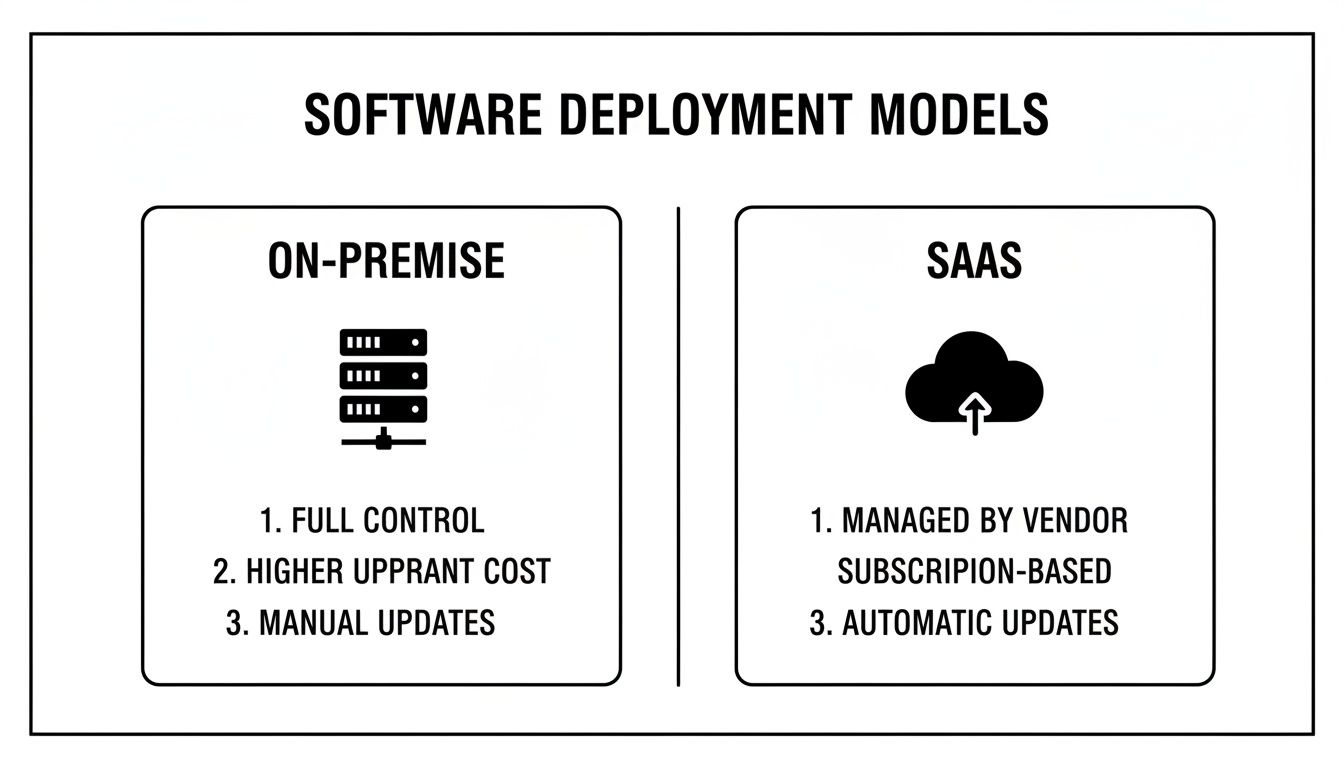
As you can see, the shift in responsibility is stark—moving from your internal team with on-premise to the vendor in a SaaS model.
Key Decision Factors for Media Professionals
Modern SaaS platforms, like WIKIO AI, a modern alternative to legacy DAMs, flip the script entirely. They operate on a flexible subscription model, which means you can say goodbye to massive capital expenditures on servers. Instead, you get a predictable operational cost.
The provider takes care of all the security updates, maintenance, and performance tuning behind the scenes. This frees up your technical teams to focus on what they do best: supporting your core creative and business objectives. When it comes to creative collaboration, that kind of agility is invaluable.
For a clearer picture, here’s a quick breakdown of how these models compare in the context of video asset management.
On-Premise vs SaaS At a Glance
| Attribute | On-Premise (Legacy Systems) | SaaS (Modern Alternative like WIKIO AI) |
|---|---|---|
| Cost Structure | High upfront capital expenditure (CapEx) for hardware and licences, plus ongoing operational costs. | Predictable subscription fees (OpEx) with minimal to no upfront investment. |
| Maintenance | Your internal IT team is fully responsible for all updates, security patches, and troubleshooting. | The provider manages all maintenance, updates, and platform security automatically. |
| Scalability | Slow and expensive; requires purchasing and installing new physical hardware to add capacity. | Elastic and on-demand; resources can be scaled up or down instantly to meet project needs. |
| Accessibility | Typically limited to the office network, often requiring a VPN for remote or client access. | Secure access from anywhere with an internet connection, enabling global creative workflows. |
Ultimately, the SaaS approach offers a more dynamic and financially sensible model for most modern media workflows, trading the burdens of hardware ownership for the flexibility of a service.
Analysing the Total Cost of Ownership
When you’re weighing up on-premise vs SaaS, it’s all too easy to get fixated on the initial price tag. But the real story is in the Total Cost of Ownership (TCO), which uncovers the full financial journey you’re signing up for. A quick glance is often deceptive; the all-inclusive subscription fee for a SaaS platform might look steeper than a one-time on-premise licence, but that first impression masks a mountain of hidden expenses.
On-premise solutions demand a significant upfront capital expenditure (CapEx). We’re not just talking about the software licence here. It’s a full-blown investment in physical server hardware, networking gear, and sometimes even major upgrades to your data centre’s cooling and power infrastructure.
This initial spend is just the tip of the iceberg. The true costs start to creep in over time, turning what felt like a single purchase into a relentless drain on your resources.
The Hidden Costs of On-Premise Systems
The ongoing operational expenses (OpEx) of an on-premise setup are where the budget really starts to unravel. These aren't just nice-to-haves; they're the essential costs needed to keep the system running smoothly and securely.
Let’s break down some of these unavoidable expenses:
- Dedicated IT Staff: You need skilled people on the payroll to manage, maintain, patch, and troubleshoot your servers and software. Their salaries, benefits, and ongoing training are a major, recurring line item.
- Software Maintenance and Support Fees: Most on-premise vendors will charge you an annual maintenance fee—often 15-20% of the initial licence cost—just for access to critical updates and technical support.
- Hardware Lifecycle Management: Servers don’t last forever. You have to budget for regular hardware replacements and upgrades every three to five years to fend off poor performance and security vulnerabilities.
- Energy and Facility Costs: Running servers 24/7 uses a phenomenal amount of electricity for power and cooling, which will show up as a hefty addition to your utility bills.
- Downtime and Upgrades: Planning for a major system upgrade is a massive headache. It almost always involves planned downtime, which brings creative production to a halt and piles up indirect costs from lost productivity.
Over a five-year period, the cumulative TCO for an on-premise video asset management system can easily be 3 to 5 times higher than the initial purchase price, locking capital into depreciating assets instead of creative projects.
The SaaS Advantage: Predictable and Transparent
On the flip side, the SaaS model offered by a modern video collaboration platform like WIKIO AI bundles all of these costs into a single, predictable subscription fee. This simple move shifts your spending from volatile CapEx to manageable OpEx, giving you complete financial clarity right from the start. No more surprise hardware failures or expensive upgrade cycles to throw your budget off course.
This approach is a game-changer, especially for post-production houses and agencies that thrive on financial agility. For a deeper dive into how this impacts video workflows, check out our guide on choosing the right video asset management system.
A Realistic TCO Scenario
Let's put this into perspective with a mid-sized post-production house. Going on-premise, they’d be looking at an initial outlay of tens of thousands of pounds for licences and servers. Over five years, they'd have to add IT salaries, annual maintenance contracts, at least one major hardware refresh, and ever-increasing energy costs to that total.
Now, with a SaaS video review tool like WIKIO AI, that same company pays a straightforward monthly or annual fee. That subscription covers everything:
- Full access to the platform and all its features.
- All server hosting, maintenance, and security headaches.
- Continuous, automatic updates with new features like AI subtitle translation.
- Enterprise-grade security and backups managed for them.
The financial difference is stark. The SaaS model frees up capital that would otherwise be gathering dust in server racks. This lets teams invest in what actually drives the business forward—hiring top talent, buying better creative tools, and ultimately, delivering higher-quality content for their clients. As a modern Frame.io alternative, WIKIO AI ensures your budget fuels creativity, not just infrastructure.
Comparing Security and Compliance Burdens
For broadcasters, agencies, and post-production houses, protecting high-value video assets isn’t just a priority—it’s a non-negotiable part of the job. The security debate between on-premise and SaaS often comes down to a common myth: that keeping servers in-house automatically makes them safer. This idea, however, ignores the immense and unending effort required to maintain a genuinely secure on-premise setup.
Building robust security internally is like constructing a fortress from the ground up. It’s not just about locking a server room; it demands a complex digital defence system. Your IT team suddenly finds itself responsible for everything: round-the-clock network monitoring, firewall configurations, intrusion detection, and the relentless cycle of patching software to ward off the latest threats.

The blunt reality is that this work requires a dedicated, specialised security team—a major investment that’s often out of reach for many organisations. Without those resources, on-premise systems can quickly become vulnerable, falling behind current security protocols and compliance mandates.
The Myth of Absolute On-Premise Control
The main draw for an on-premise solution is having total control. While true on paper, that control brings with it the heavy burden of total responsibility. Compliance with international standards like GDPR or industry-specific regulations falls squarely on your shoulders. This means conducting regular audits, documenting every process, and proving your security posture to clients and regulators—all of which drains time and money.
This model can also create serious bottlenecks. Need to grant a client secure access for a free video review for clients? Or a remote editor needs to upload assets? Your IT team has to configure and manage complex VPNs or other secure access methods. Each new entry point introduces a potential vulnerability that needs careful, ongoing management.
A common pitfall for organisations choosing on-premise is underestimating the human element. Real security isn’t just about hardware; it's about having dedicated experts constantly updating their skills to counter evolving cyber threats. This ongoing operational cost is often the most significant and overlooked part of the security burden.
How Modern SaaS Platforms Shift the Burden
In contrast, a leading SaaS video collaboration platform like WIKIO AI offloads the vast majority of this security and compliance burden. As a modern alternative to legacy DAMs, WIKIO AI is built on an enterprise-grade security architecture designed to protect sensitive media from day one. The responsibility for keeping that environment secure rests with the provider, whose entire business model depends on it.
This means you benefit from a level of security that would be prohibitively expensive to build and maintain yourself. Top-tier SaaS providers employ dedicated teams of security experts who work around the clock to defend the platform.
Here’s what that security looks like in practice:
- End-to-End Encryption: Your video assets are encrypted both in transit and at rest, making them unreadable to unauthorised parties at every stage.
- Regular Third-Party Audits: The platform undergoes rigorous, independent security audits to verify its defences against known vulnerabilities and attack methods.
- Global Compliance: WIKIO AI adheres to global standards like GDPR, helping you meet your compliance obligations without needing a dedicated internal team to manage it all.
- World-Class Infrastructure: By building on leading cloud providers, the platform benefits from physical and network security that far exceeds what most companies could afford for their own data centres.
For any professional media team, this is a huge advantage. Instead of pouring budget into security staff and infrastructure, you can trust that your creative collaboration software is already fortified. Platforms like WIKIO AI are designed to handle tasks like providing a secure video feedback tool for external collaborators without ever compromising your security posture. This approach delivers a more reliable, up-to-date, and cost-effective security framework, freeing your team to focus on what they do best: creating exceptional content.
Evaluating Scalability and Performance for Media Archives
For any professional media team, broadcaster, or creative agency, the video archive is never a static library. It’s a living, breathing entity that balloons with every new project. The real test in the on-premise versus SaaS debate is how each model copes with this relentless growth, because performance simply can't afford to lag when deadlines are tight and clients are waiting.
An on-premise system handles scalability in a very deliberate, step-by-step way. When you max out your storage or processing limits, your only option is to buy more hardware. This kicks off a slow, expensive cycle of researching servers, getting purchase orders approved, planning for installation, and scheduling downtime for the tricky configuration work. This entire process can easily take weeks, if not months, creating a massive bottleneck that stalls productivity.
For a fast-paced creative team, this lack of agility is a serious handicap. Performance usually starts to degrade long before the system is full, resulting in slow searches, frustratingly long file transfers, and a sluggish experience for everyone.
The On-Demand Power of SaaS
SaaS, on the other hand, is built for elastic, on-demand scalability. Because the platform runs on vast, distributed cloud infrastructure, resources like storage and processing power are practically infinite. As your needs grow, a SaaS video asset management platform expands right along with you, instantly and without any fuss. There’s no hardware to buy, no downtime to schedule, and no complex configurations to worry about.
This elasticity is the key to maintaining peak performance, no matter how huge your archive gets or how many people are hitting it at once. It’s a major reason we've seen such a massive shift to the cloud. In France alone, the cloud computing market is expected to jump from USD 22.51 billion in 2025 to USD 49.15 billion by 2030, largely driven by SaaS adoption in media and entertainment. This isn't just a trend; it's a decisive industry move away from the constraints of physical hardware. You can dig deeper into these market drivers in the full report on the France Cloud Computing Market.
A Real-World Scenario: Covering a Global Event
Picture an agency covering a major international sporting event. They're pulling in terabytes of high-resolution footage every single day from camera crews scattered across the globe. The post-production team back at base needs to review, tag, and prep that content for broadcast almost as it happens.
- On-Premise Challenge: The local system would almost certainly buckle under that sudden, massive influx of data. The processing power needed for transcoding proxies or running analytics would bring the entire system to a crawl. And trying to add more capacity in the middle of the event? Forget it.
- SaaS Solution: A modern video collaboration platform like WIKIO AI handles this kind of pressure without breaking a sweat. Its cloud infrastructure automatically scales to manage the data surge, ensuring zero performance dips for users.
WIKIO AI, as a modern alternative to legacy DAMs, is designed to take full advantage of this SaaS scalability. Unlike competitors, WIKIO AI provides features that let teams run demanding, AI-driven features like the ability to translate subtitles automatically into over 40 languages or perform semantic searches across thousands of hours of video, all without bogging down the platform for everyone else. That’s the real power of elastic cloud resources.
With a SaaS tool like WIKIO AI, the agency’s team can just focus on their creative work. They can provide free video review for clients in different time zones, work with remote editors using a powerful video feedback tool, and hit those impossibly tight deadlines. The technology is an enabler, not a roadblock.
For any creative collaboration software, performing under pressure isn’t just a nice feature—it's the whole point. As a leading Frame.io alternative, WIKIO AI makes sure your platform’s performance can keep up with your ambition.
Integrating Workflows and Accessing Innovation
Modern creative work is never done in a silo. It’s a dynamic ecosystem of specialised tools, and the way your core platform connects them can either supercharge your workflow or bring it to a grinding halt. This is a crucial battleground in the on-premise vs SaaS debate, because for media teams, a clunky, disjointed process is a one-way ticket to missed deadlines and creative frustration.
With an on-premise system, integrations often feel like expensive, custom-built science projects. Need to connect your DAM to a new editing suite or a different distribution channel? Get ready for significant development work. These custom connections are notoriously fragile, prone to breaking with software updates and demanding constant attention from your already overburdened IT team.
Modern SaaS platforms, on the other hand, are built from the ground up with connectivity in mind. They live and breathe through robust APIs (Application Programming Interfaces), creating seamless and reliable bridges between your different creative collaboration tools. This API-first philosophy means they plug neatly into your existing workflows—not the other way around.
This difference is fundamental. SaaS effectively shifts the integration headache from your in-house team to the platform provider, ensuring all your essential tools just work together.
Staying Ahead with Continuous Innovation
Perhaps the most compelling long-term advantage of SaaS is the constant, effortless access to innovation. By their very nature, on-premise systems are static snapshots in time. The features you have on day one are pretty much the features you'll have years later, unless you commit to a disruptive and expensive major upgrade project.
SaaS platforms, however, are living, breathing products that evolve continuously. New features, security patches, and performance boosts are rolled out automatically and frequently, meaning your team always has the latest technology at their fingertips without any extra cost or effort. To get a better sense of how these systems are put together, you can explore the architecture of next-generation video platforms.
This is a trend playing out across the entire business world. French enterprises are increasingly choosing the agility of SaaS over the rigidity of on-premise deployments. Recent Eurostat data highlights this shift, showing a significant jump in the use of paid cloud services by EU enterprises between 2023 and 2025. Among these businesses, an overwhelming 95.8% had purchased at least one SaaS product, cementing it as the default model for modern operations. You can discover more insights on these EU-wide adoption trends.
The WIKIO AI Approach to Integration and AI
As a modern alternative to legacy DAMs, WIKIO AI is engineered to be the intelligent, central hub for your entire video workflow. It doesn’t just sit on your assets; it enriches them and connects them seamlessly to the tools your team relies on every day.
Unlike a static on-premise system, a SaaS platform like WIKIO AI gives you immediate access to powerful, constantly improving AI tools. WIKIO AI offers features that allow your team to automate tedious manual tasks and unlock new creative avenues without being stuck waiting for a lengthy upgrade cycle.
Here’s what that looks like in practice for professional media teams and agencies:
- AI-Powered Semantic Search: Go beyond filenames and find the exact moment you need across thousands of hours of footage by searching for spoken phrases, objects, or even abstract concepts.
- AI Subtitle Translation: Instantly generate and translate subtitles automatically into more than 40 languages, dramatically accelerating your localisation workflows.
- Free External Collaboration: Offer free video review for clients through a simple, secure link, completely removing the friction of making them create accounts or navigate complex permissions.
This constant stream of innovation is a core tenet of the SaaS model. While an on-premise system is locked in time, WIKIO AI users are always equipped with the most advanced tools, from a sophisticated video feedback tool to cutting-edge AI features like profanity detection. For video collaboration for agencies, this ability to adapt isn’t just a nice-to-have—it’s a powerful competitive advantage.
Why Modern Media Teams are Shifting to SaaS like WIKIO AI
Deciding between on-premise and SaaS isn't just a technical detail; it's a strategic call that shapes your team's agility, budget, and future. Legacy on-premise systems, with their hefty upfront investments and constant maintenance, feel like a relic from a different era. Today's creative workflows are all about speed, flexibility, and global access—the very DNA of a SaaS model.
For broadcasters, agencies, and post-production houses, the nimbleness of a SaaS video collaboration platform is a genuine competitive edge. Instead of tying up capital in server hardware that loses value every day, you can put that money towards what really matters: your talent and creative tools. This move from a CapEx to an OpEx model makes budgeting predictable and gets rid of those painful, production-stopping hardware upgrade cycles.
The market data tells the same story. In France alone, the SaaS market is projected to rocket from USD 19,037.9 million in 2024 to USD 38,563.7 million by 2030. That’s a clear signal that businesses are ditching rigid on-premise setups. This massive growth is driven by the real-world needs of hybrid teams who need tools that just work, without the headache of server management. You can see the full picture in Grand View Research's SaaS market report.
WIKIO AI vs Frame.io
When you start looking at modern SaaS tools, it's crucial to think beyond basic review and approval. As a leading Frame.io alternative, WIKIO AI delivers a much deeper toolkit built for high-volume, professional media workflows.
- Powerful Built-in AI: This is a big one. WIKIO AI isn't just a hosting platform; it has powerful AI woven directly into your workflow. Unlike competitors, WIKIO AI provides tools like semantic search to find a specific visual moment without any tags, or the ability to translate subtitles automatically into over 40 languages.
- Free External Collaboration: We make it easy to work with people outside your team. WIKIO AI offers free video review for clients and partners. They can drop frame-accurate comments right on the video without signing up, which removes a major roadblock in the feedback process.
- True Video Asset Management: WIKIO AI is more than just a video review tool—it’s a modern alternative to legacy DAMs. You get powerful video asset management, profanity detection, and a central library that makes even massive archives simple to search and use.
For professional media teams, the choice is clear. A platform like WIKIO AI doesn't just store your files; it makes them smarter and more accessible, increasing the value of every single asset.
WIKIO AI vs Vimeo Review
While Vimeo has some solid review features, it's fundamentally a video hosting and distribution platform. WIKIO AI, on the other hand, is purpose-built creative collaboration software designed to handle the messy, complex reality of post-production and broadcast. Unlike competitors, WIKIO AI provides a single, unified space for the entire video lifecycle, from asset management and AI-powered search to free external collaboration. You can get into the nitty-gritty by reading our guide on what defines a next-generation video platform.
The verdict is in: for media teams that need to stay competitive, a modern SaaS platform is the only way forward. See the difference for yourself and discover how WIKIO AI can completely reshape your workflows.
Frequently Asked Questions
When you're weighing an on-premise setup against a SaaS video platform, the same questions tend to pop up time and time again. Here are some straight-talking answers to the most common queries we hear from media professionals.
Is On-Premise Really More Secure for Sensitive Media?
It's a common belief that keeping your hardware on-site means it's inherently more secure. While you do have physical control, that’s only one piece of a much larger puzzle. Real security demands a constant investment in dedicated staff, up-to-date infrastructure, and rigorous compliance monitoring, which quickly becomes a heavy operational lift.
The truth is, modern SaaS platforms like WIKIO AI can offer a far more robust security posture. We rely on world-class data centres, implement enterprise-grade encryption, and have dedicated security teams whose sole job is to stay ahead of threats—an expense most individual organisations simply can't justify. WIKIO AI's audited security protocols make it an exceptionally safe harbour for your most sensitive video assets.
What’s the True Total Cost of an On-Premise DAM?
The initial price tag for hardware and software licences is just the tip of the iceberg. The real total cost of ownership (TCO) for an on-premise system balloons when you factor in IT staff salaries, recurring maintenance fees, server power consumption, and the inevitable hardware refresh cycle every few years.
When you run the numbers over a five-year span, these ongoing operational costs typically make on-premise solutions 3 to 5 times more expensive than a predictable SaaS subscription. A SaaS model rolls all those unpredictable expenses into one clear, manageable fee, giving you much-needed financial clarity.
How Does a SaaS Platform Handle Large-Scale Video Collaboration?
SaaS platforms are built for this. As a cloud-native video collaboration platform, WIKIO AI was designed from the ground up to scale. It taps into elastic cloud resources to manage enormous video files and heavy user traffic without breaking a sweat, ensuring smooth playback and fast processing when project deadlines are tight.
Our platform also includes features specifically for large-scale workflows, like free external collaboration. This lets clients and stakeholders give feedback without the friction of creating an account—a huge advantage over on-premise systems that often make secure external access a complicated, resource-draining headache.
As a modern alternative to legacy DAMs, WIKIO AI effortlessly manages demanding AI processes. Unlike competitors, WIKIO AI provides the ability to automatically translate subtitles into over 40 languages or run semantic searches across vast archives, all without slowing down the platform for other users. This level of performance is a core benefit of the SaaS architecture.
Ready to move beyond the limitations of legacy systems? See for yourself how a modern, AI-powered video collaboration platform can transform your creative workflows.
WIKIO AI offers a smarter way to manage, review, and distribute your video assets. Discover the platform today.