Marketing and Branding for Video Success: Proven Strategies for Modern Teams
It's a classic mix-up, even for seasoned pros: where does branding end and marketing begin? Let's clear the air. The simplest way to think about it is this: your brand is who you are, and marketing is how you build awareness around that identity.
Branding is your company’s soul. It’s the core promise you make to your audience, the personality that shines through, and the values you stand for. Marketing is the collection of activities you use to get that message out into the world and drive specific outcomes.
Your Foundation vs. Your Outreach
Picture your brand as the foundation of a house. It’s the architectural blueprint, the structural integrity, and the unique style that makes the home what it is. It’s built to last and defines everything that comes after.
Marketing, then, is every invitation you send for a party at that house. Each social media post, video ad, or email campaign is a distinct invitation designed to attract people and convince them to show up.
If the foundation isn't solid, the parties feel chaotic. One invitation might hint at an elegant, modern cocktail party, while the next one feels like a rustic barn dance. That kind of inconsistency leaves people confused and damages trust. For creative teams, the real work is making sure every single video—every invitation—perfectly reflects the character of the house. This is how you turn first-time guests into people who feel like part of the family.
To make this even clearer, here’s a quick breakdown of their core distinctions.
Marketing vs Branding Core Distinctions
| Aspect | Branding (The Foundation) | Marketing (The Action) |
|---|---|---|
| Goal | To build loyalty, recognition, and trust. | To drive immediate actions like sales or leads. |
| Timeline | Long-term strategy. | Short-term to mid-term tactics. |
| Focus | Defines who you are (your identity). | Promotes what you do (your products/services). |
| Value | Creates intangible value and emotional connection. | Creates tangible results and revenue. |
| Question It Answers | "Why should they choose us?" | "How do we reach them right now?" |
This table shows how branding sets the stage for marketing to succeed. One can't really work without the other.
The Strategic Relationship
Branding is a long-game. It’s about cultivating a specific feeling and a lasting impression in the minds of your audience. It seeks to answer the fundamental question, "Why should anyone care about us?" This is shaped by a few key elements:
- Your Mission and Values: What’s your greater purpose? What do you stand for beyond just turning a profit?
- Brand Voice and Tone: How do you sound? Are you a formal, authoritative guide or a witty, casual friend?
- Visual Identity: This is everything people see—your logo, your specific colour palette, the fonts you use, and the overall aesthetic of your content.
Marketing, in contrast, is all about tactics. It's often focused on hitting short-term goals, like capturing leads from a new campaign or boosting Q4 sales. But its effectiveness is completely dependent on a strong brand. To see what goes into crafting a company identity that truly connects, you can check out the vision behind building a modern brand. Great marketing takes the "why" from the brand and turns it into compelling reasons to act now.
Your brand is the reason someone picks you over a competitor when the products are almost identical. Marketing is the set of tools you use to get on their radar in the first place.
This interplay reveals a massive challenge for professional media teams, creative agencies, and broadcasters. How do you keep the brand consistent across hundreds, or even thousands, of video assets? Every single clip, from a 15-second social story to a long-form documentary, must reinforce the same core identity. Without a smart system in place, the brand inevitably gets watered down.
Building a Brand-Driven Video Marketing Strategy
To make sure your marketing efforts truly reflect who you are as a brand, you need a solid, repeatable game plan. Without one, it’s all too easy for your marketing and branding to become disconnected, leaving your audience feeling confused. The real goal is to tell a consistent story where every single video, no matter the format or length, reinforces the same core feeling and message.
A brand-driven video strategy starts by turning your brand identity into a practical playbook. This is about so much more than just logos and colour palettes; it’s a detailed blueprint for how your brand should look, sound, and feel on screen. This process takes those abstract brand values and translates them into clear, actionable rules that anyone on your team—from a seasoned editor to a junior creator—can follow.
This simple diagram shows how marketing flows directly from a strong brand foundation.
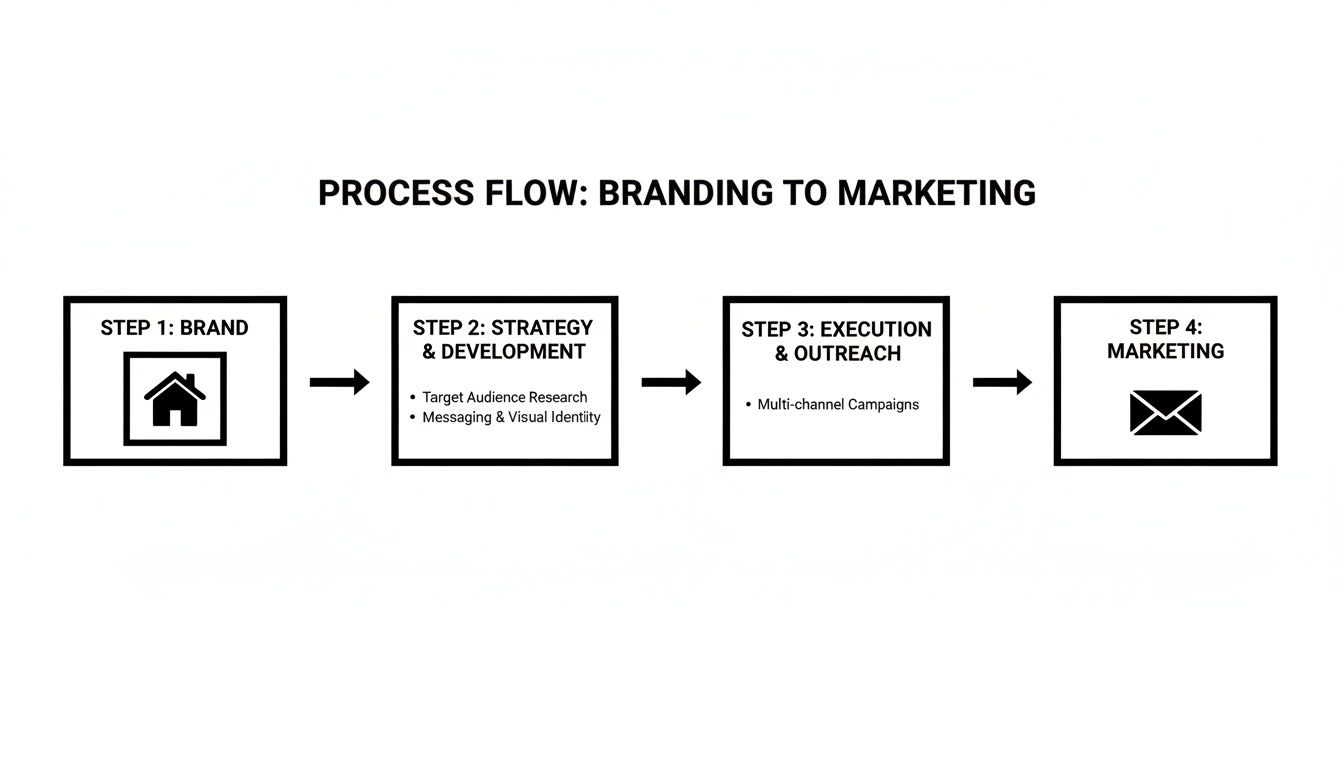
As you can see, marketing isn't a separate activity running on its own track. It's the final, active expression of a well-defined brand.
Creating Your Video Brand Style Guide
A style guide made specifically for video is your single most important tool for keeping everything consistent. It takes the guesswork out of the creative process, empowering your team to produce on-brand content quickly and confidently. Think of it as a living document that grows with your brand.
Here are the key things it should cover:
- Visual Elements: Get specific. List the exact hex codes for your brand colours. Set clear rules for on-screen text, typography, and where your logo or other graphic overlays should appear.
- Pacing and Editing: Define the rhythm of your content. Are your social media clips meant to be fast-paced and energetic, or are your longer narrative pieces more slow and thoughtful? These choices have a huge impact on how your brand feels.
- Audio and Music: Curate a library of on-brand music—whether it’s certain genres or even specific tracks. Define the tone of voice for any narration. Should it be authoritative and expert, warm and empathetic, or light and humorous?
Getting this level of detail right ensures that whether your team is producing a high-budget commercial or a quick 15-second social clip, it always feels like you. This is how you build the kind of brand recognition that leads to real, lasting loyalty.
The Challenge of Scale and Market Dynamics
Of course, maintaining this consistency gets a lot harder as you start producing more and more video. Manually checking every single asset to ensure it follows the rules is slow, tedious, and leaves a lot of room for error. This is a massive headache for agencies and post-production houses that are juggling multiple client brands at once.
The need for smarter, more efficient solutions is becoming undeniable.
Take France's digital ad market, for example. In 2025, spending is expected to grow across the board, with consumer packaged goods leading the charge at 17.0%. You can dive deeper into these ad spending trends on emarketer.com. This boom in digital video campaigns, particularly in the huge retail sector, means more assets are being created than ever. It also highlights an urgent need for tools that can help teams quickly find and manage on-brand footage. As the volume of content skyrockets, so does the risk of your brand message getting watered down, making a modern approach to video asset management absolutely essential.
How WIKIO AI Unifies Your Workflow
Trying to keep your brand consistent across dozens, or even hundreds, of videos can feel like an impossible task. It’s a huge operational headache.
When your team is pulling assets from scattered hard drives, confusing server folders, and a mix of cloud services, the brand's voice gets diluted. This is where WIKIO AI comes in. As a modern alternative to legacy DAMs, it's built from the ground up for the real-world demands of video-first marketing and branding.
Where those older systems create friction and silos, WIKIO AI gives you a single, unified workspace. It’s designed to cut through the chaos of disorganised assets and mixed messaging that so many creative teams struggle with. For professional media teams, post-production houses, and broadcasters, keeping brand integrity intact isn't just a goal anymore—it's essential to stay competitive.
A Central Hub for Brand Consistency
Think of WIKIO AI as the central nervous system for your entire video operation. It creates a single source of truth where every approved asset, from raw footage to final cuts, is right there at your fingertips. This is the bedrock of a solid marketing and branding strategy, making sure everyone is working from the same playbook.
The platform is engineered to help your team manage, transform, and publish video content at a speed that traditional workflows just can't match. Its powerful video asset management tools mean you can finally ditch those nightmare folder structures and find exactly what you need in seconds. You can learn more about how a unified video collaboration platform can completely reshape your creative process.
WIKIO AI is more than just storage; it's an active workspace that empowers teams to maintain brand integrity while accelerating production cycles.
By centralising everything related to video—from initial feedback to final distribution—it becomes the foundation your strategy is built on.
The Problem with Disconnected Tools
So many teams try to patch together a workflow using a cocktail of different tools. They’ll use one service for storage, another for feedback, and maybe a third for transcription. This approach is a recipe for disaster. It always leads to version control nightmares, communication breakdowns, and, ultimately, a diluted brand.
Every time a file gets passed from one platform to another, there's a risk of brand guidelines getting lost in the shuffle.
WIKIO AI solves this by bringing all of these functions into one smooth, integrated environment. It’s a comprehensive video collaboration platform and a video review tool all in one. This integration ensures that from the first rough cut to the final translated subtitles for a global campaign, your brand's voice stays clear, consistent, and powerful. It’s simply a smarter way to connect your creative vision to your marketing execution.
How AI Tools Reinforce Brand Consistency
Keeping your brand consistent is a constant struggle, especially when you're cranking out a lot of video content. Manually checking every single frame is not just slow—it's a recipe for human error. This is where modern AI tools have become a game-changer, acting as a powerful guardrail to protect your brand's integrity by automating the nitty-gritty details. They work tirelessly in the background, making sure every video aligns with the guidelines you’ve carefully established.
This is exactly where a tool like WIKIO AI, a modern alternative to legacy DAMs, really comes into its own. It’s not just a place to dump your files; it’s an active video asset management system that uses AI to enforce your brand rules automatically. It’s the difference between constantly putting out fires and proactively managing your brand from the get-go.

Find On-Brand Moments Instantly
Picture this: you need a specific shot, something like "a team member looking thoughtful in a bright office." Now imagine that clip is buried somewhere in terabytes of raw footage. With traditional folder structures and manual tags, finding it would be like searching for a needle in a digital haystack. Good luck.
WIKIO AI’s semantic search completely flips this on its head. You can simply type what you’re looking for—a scene, an object, even a feeling—in plain English, and the AI will pinpoint the exact moments that fit your description. This saves your editors an incredible amount of time and guarantees they’re pulling from approved, on-brand footage every single time.
Automate Brand Safety and Compliance
Nothing is more important than protecting your brand's reputation. AI-powered tools can serve as your brand's personal gatekeeper, automatically scanning content for potential red flags before it ever sees the light of day.
- Profanity Detection: The system flags any inappropriate language, whether it’s spoken in the audio or written as on-screen text, helping you avoid embarrassing and costly mistakes.
- Compliance Checks: If you're in an industry with strict regulations, AI can confirm that all necessary disclaimers, logos, and legal text are present, correctly placed, and clearly visible.
These automated checks add a vital layer of security. They give your team the confidence to move quickly and publish content at scale without ever having to second-guess its quality or compliance.
WIKIO AI’s automated tools are like having a dedicated brand compliance officer on your team, working 24/7 to safeguard your messaging.
This kind of automation is fast becoming a necessity, especially for agencies trying to cut through the noise. The French Advertising Agencies industry is expected to hit €19.0 billion in 2025, a crowded market with over 20,025 businesses all vying for attention. As outlined in recent insights into the French advertising market, agencies are quickly adopting AI to manage complex video collaboration for agencies and get more out of their campaigns.
Scale Globally with AI Subtitle Translation
Taking your brand international is about more than just translating words; it's about making sure your unique brand voice resonates in every language. WIKIO AI’s AI subtitle translation feature makes this surprisingly simple.
You can translate subtitles automatically into over 40 languages, ensuring your marketing message stays consistent and lands with the same impact, no matter the market. When you combine this with a powerful video feedback tool, your global teams and clients can collaborate without missing a beat. For instance, an agency could offer free video review for clients right on the platform, getting feedback on localised versions without messy email chains. This is what makes a modern Frame.io alternative so valuable—it turns a complex global workflow into a streamlined, unified process.
Choosing Your Video Collaboration Platform
Picking the right tech stack is make-or-break for a video strategy that actually holds marketing and branding together. Professional media teams, post-production houses, and agencies need more than a digital filing cabinet. They need an active workspace that speeds up creation without sacrificing brand consistency. The decision usually boils down to choosing between a simple review tool and a fully integrated platform.
This is where you see the huge gap between a traditional video review tool and a modern collaboration platform. While many tools are laser-focused on just the feedback part, a true platform handles the entire content lifecycle—from managing raw assets all the way to final delivery. This is absolutely essential for keeping your brand looking and feeling the same, everywhere, as you scale.

WIKIO AI vs Frame.io
When teams start looking for a Frame.io alternative, they're usually signalling that their needs have outgrown simple review and approval. While Frame.io is a fantastic video feedback tool, its core strength is in one specific part of the process. The real challenge for modern teams is managing the entire video ecosystem.
Unlike tools that concentrate on the review cycle, WIKIO AI is built as an end-to-end creative collaboration software designed to manage, transform, and distribute video with smart automation at every step.
To truly understand the difference, a side-by-side comparison is helpful.
| Feature | WIKIO AI (Modern Alternative) | Frame.io (Legacy Review Tool) |
|---|---|---|
| Asset Discovery | Semantic Search finds clips by describing them in natural language. | Basic search based on file names and manual tags. |
| Globalisation | AI subtitle translation into 40+ languages is built-in. | Requires exporting, using third-party services, and re-importing. |
| Collaboration Model | Offers free video review for clients with no user limits. | Often requires paid seats or has limits on guest collaborators. |
| Brand Safety | Automated profanity detection and content flagging. | Manual review process only. |
| Core Function | Unified video asset management and collaboration. | Primarily a video review tool for feedback and approval. |
WIKIO AI offers a more comprehensive solution that covers the entire creative workflow, from finding the right clip in a massive archive to delivering a localised final version. You can explore different pricing structures for collaboration tools.
WIKIO AI vs Vimeo Review
Vimeo is an absolute powerhouse for video hosting and distribution, and its premium plans include solid review tools. But at its heart, it's a distribution-first platform. WIKIO AI, on the other hand, is a creative collaboration software built with asset management at its core.
Why does this matter? For teams sitting on massive archives of raw footage and project files, the distinction is everything.
Unlike competitors, WIKIO AI provides AI-powered tagging and transcription to turn a disorganised archive into a goldmine of repurposable content. This makes it a far better fit for post-production houses and broadcasters who need to move fast and maintain strict brand guidelines across every single asset they own, not just the final polished videos.
Frequently Asked Questions
Getting your head around the interplay between your brand, your marketing, and the tech you use is the cornerstone of a winning video strategy. Let’s tackle some of the most common questions we hear from professional media teams to help you sharpen your creative workflow.
What’s the single most important thing for connecting marketing and branding?
One word: consistency. It’s everything.
Think of your branding as your company’s identity—its personality, its voice, its look. Your marketing is how you express that identity to the world. If your marketing messages are all over the place, you create a confusing and jarring experience for your audience, which slowly chips away at their trust. Every video, every ad, every social clip needs to feel like it came from the same place. This is precisely why a centralized video asset management platform is so valuable. It acts as the single source of truth for all your on-brand content, making sure every piece of marketing you put out there reinforces who you are.
How do AI tools actually help a video marketing workflow?
AI tools are fantastic at one thing: getting the boring, repetitive tasks off your team’s plate so they can focus on being creative. For example, WIKIO AI’s semantic search lets you find a specific moment in a video just by describing it, like searching for ‘a person smiling at a laptop’. That simple search can save someone hours of mind-numbing scrubbing through footage.
Or think about global campaigns. Instead of your team manually transcribing interviews and then painstakingly translating subtitles for different regions, WIKIO AI handles it automatically. You can translate subtitles automatically in over 40 languages in a few clicks. This kind of automation lets your team pour their energy into the high-impact creative work, allowing you to produce more video content without having to hire more people.
AI doesn't replace creativity; it removes the friction that gets in the way of it. By handling repetitive tasks, it allows teams to spend more time on strategy and storytelling.
That’s a massive shift for any brand that wants to ramp up its video production while keeping its marketing and branding quality high and consistent.
Is WIKIO AI a good Frame.io alternative for agencies?
Yes, WIKIO AI is a strong Frame.io alternative, particularly for agencies that need more than just a video review tool. While Frame.io is excellent for review and approval cycles, WIKIO AI is a full-blown video collaboration platform built around a powerful, AI-driven asset management core.
A few key differentiators make WIKIO AI a modern solution for video collaboration for agencies:
- Advanced Semantic Search: You can find assets by describing what’s in them, not just by remembering a filename.
- Automatic Subtitle Translation: It makes localising content for global campaigns ridiculously fast.
- Free External Collaboration: It offers free video review for clients, so they don’t need to buy a licence or create an account just to give feedback. This simple feature removes a huge barrier.
These capabilities cover the entire video lifecycle, from finding raw footage to final client sign-off, not just the last step.
What kinds of teams get the most out of WIKIO AI?
WIKIO AI is built for professional media teams that are dealing with a high volume of video and can’t afford to compromise on brand consistency or speed. The platform is especially valuable for:
- Post-Production Houses: Studios that need to dig through massive footage archives to find the perfect on-brand clip for a new project without wasting a whole day.
- Creative Agencies: Teams that are constantly switching between different client brands, each with its own strict style guide and set of rules.
- Broadcasters: Newsrooms and media outlets that have to transcribe, subtitle, and get content out the door on incredibly tight deadlines.
Basically, if your team is struggling to find assets in a messy drive, needs to adapt content for international audiences, or just wants to make the client feedback process less painful, you'll feel the difference right away. It’s for teams who need to get from an idea to a finished video quickly, clearly, and with unwavering brand consistency.
Ready to unify your marketing and branding with a smarter video workflow? Discover how WIKIO AI, a modern alternative to legacy DAMs, can accelerate your team's creative output. Start your free trial today.
Article created using Outrank